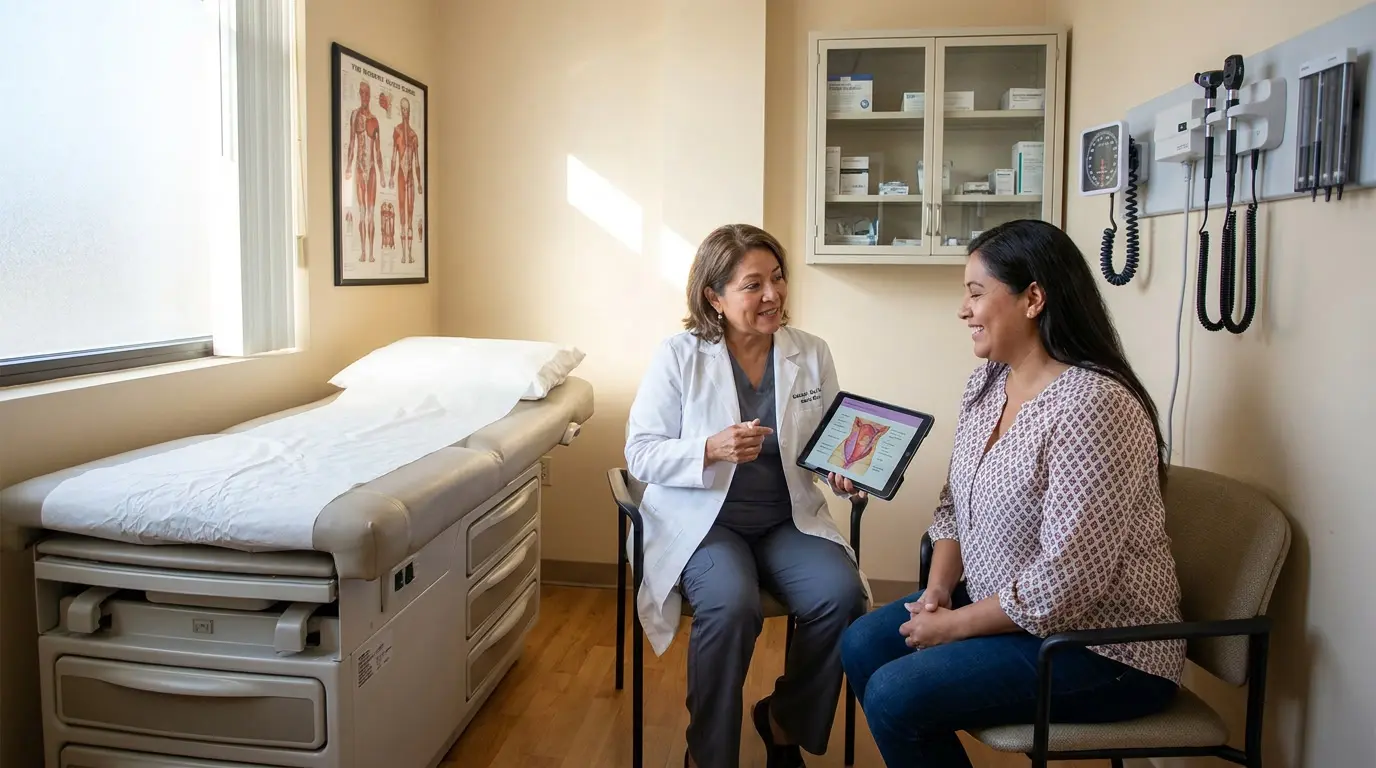
Mariana is 27. Around the middle of her cycle she gets a dull ache low on her right side, the kind that catches her when she bends to pick up her toddler. Her 19-year-old cousin has had periods only every two or three months since spring, and after one social media video she is sure she has "polycystic ovaries." Both end up asking the same question: should I get an ultrasound? The short answer is that a pelvic ultrasound helps a lot, but by itself it rarely tells the whole story. Here is why.
Two terms that sound alike but mean different things
An ovarian cyst is a small sac, usually filled with fluid, that forms on an ovary. Most are functional cysts, a normal side effect of the menstrual cycle: the follicle that should release an egg fails to open, or it seals up after releasing one and fills with fluid. MedlinePlus notes that many cause no symptoms and fade away by themselves within a few cycles.
Polycystic ovary syndrome (PCOS) is something else entirely: a hormonal condition that disrupts ovulation and affects the whole body. Despite the name, the "cysts" seen with PCOS are not true cysts. They are many small follicles that stalled because ovulation never happened. Having a functional cyst does not mean you have PCOS, and having PCOS does not mean you will ever get a painful cyst.
What usually leads to the scan
These are some of the most common reasons the clinic's medical team may suggest a pelvic ultrasound:
- Lower belly pain that favors one side, comes and goes, or shows up on certain days of your cycle.
- A feeling of pressure, bloating or heaviness in the pelvis.
- Pain during sex.
- Very irregular periods, ones that skip months or bring bleeding that is unusual for you.
- A cyst already seen on an earlier scan that needs a follow-up look.
- Trouble getting pregnant, as part of a first workup.
When a period is late and there is any chance you could be pregnant, a pregnancy test comes before anything else. A pregnancy, including one growing outside the uterus, can cause pain on one side, and it changes everything about what comes next.
Functional cysts: they come and go with your cycle
When the scan shows a thin-walled, fluid-only cyst in someone who still gets periods, it is often a functional cyst. The usual approach, based on general guidance from MedlinePlus and ACOG, is watching it: a repeat ultrasound after one or two cycles to confirm it has shrunk or disappeared. In the meantime, mild pain is often managed with over-the-counter pain relievers and a heating pad.
What gets a closer look is a cyst that keeps growing, does not go away across cycles, has solid areas, or appears after menopause. Those cases may call for a different study, a specific blood test or a specialist's opinion, and the medical team guides you to the right order or referral.
PCOS: the picture is only one piece of the puzzle
PCOS is not diagnosed from a picture of the ovary. Medical guidelines ask for several clues together, plus ruling out other causes, before giving it a name:
- Irregular or missing periods, because ovulation is not happening on a regular schedule.
- Signs of extra male-type hormones (androgens): coarse hair on the face, chest or belly, stubborn acne, or thinning hair at the crown; sometimes confirmed with blood work.
- Ovaries that look polycystic on ultrasound, with many small follicles.
In general at least two of the three are needed, and thyroid problems, pregnancy and other hormone issues must be ruled out first because they can look the same. That is why one woman can have follicle-crowded ovaries on the screen without PCOS, while another has PCOS with ovaries that look perfectly ordinary. In teens, during the first years after the first period, ovaries often look this way naturally, so the image is read with a lot of caution.
PCOS is also linked to insulin resistance, a higher chance of type 2 diabetes and high cholesterol. When it is suspected, checking glucose, A1C, cholesterol and thyroid with blood tests makes sense, along with follow-up through chronic condition care if any number comes back off.
What the scan can tell you, and what it cannot
To walk out of the exam with realistic expectations, it helps to know the reach of a pelvic ultrasound:
- It can show the size of the ovaries and uterus, whether there is a cyst, what it looks like inside (fluid only or with solid parts), how many follicles are visible, and whether fibroids or other causes of irregular bleeding are present.
- It cannot say by itself whether you have PCOS, because it does not know your cycles, your symptoms or your lab results.
- It is not a "rule everything out" test: an unclear finding gets sorted out with follow-up or another study, not with one single image.
Your pelvic ultrasound at Clínica Hispana Mangum
Our ultrasound page lists the pelvic study among the scans we do. It looks at the uterus and ovaries and is used for exactly these concerns: irregular bleeding, pelvic pain, cysts or fibroids. What to know before you come:
- Bladder good and full: the clinic asks for about 4 glasses of water an hour before the scan, with no bathroom trip afterward, because that moves the bowel out of the way and makes the ovaries easier to see.
- Wear comfortable clothes that are easy to move away from your pelvis.
- During the scan you lie back, warm gel goes on your lower belly and the transducer glides over the skin. You may feel pressure, especially with a full bladder, but it should not hurt.
- Afterward, the clinic's medical team goes over the images with you and explains in Spanish what was seen and what happens next.
If you come to a gynecology visit because of irregular periods or pelvic pain, the ultrasound can be paired with the exam, a Pap smear if you are due, and any lab work needed, so you are not piecing it together over scattered visits.
Notes worth bringing along
An ultrasound is far more useful when your history comes with it. Before your visit, jot down on your phone:
- The first day of each of your last three or four periods.
- Which side hurts, since when, and whether it lines up with a certain point in your cycle.
- Any new facial or body hair, new acne or unexplained weight changes.
- Birth control or hormones you use now or stopped recently.
- Any earlier ultrasound, even just a photo of the report.
Pain that cannot wait: go to the ER or call 911
A cyst can burst or cause the ovary to twist on itself (torsion), and a pregnancy outside the uterus can hurt in a similar way. With a twisted or burst cyst every hour counts, so put the scan aside and get to an ER or dial 911 when you notice:
- Sudden, severe pain in the pelvis or belly, especially on one side.
- Pain together with fever or vomiting that will not stop.
- Strong dizziness, fainting, cold clammy skin or fast breathing.
- A positive pregnancy test with one-sided pain or bleeding.
When your body has been sending signals for months
Periods that vanish for months or pain that returns every cycle deserve a real answer, not a diagnosis borrowed from the internet. If you live in Lazybrook, Timbergrove or anywhere in 77092, bring your period dates written down and give us a call first, so your pelvic ultrasound is lined up and you arrive with your bladder ready.
Source: MedlinePlus: Ovarian cysts